




We think of Silicon Valley as a nexus of tech moguls, innovators, power brokers and venture capitalists. But something bigger and more ideological is unfolding in the Valley — the building of an entire religion. Tech evangelists talk about Artificial Intelligence as if they’re building a higher power. Elon Musk believes AI will help us find a “digital God;” while biohacker and tech entrepreneur Bryan Johnson is adamant: “I think the irony is that we told stories of God creating us,” he said in an interview earlier this year. “And I think the reality is that we are creating God. We are creating God in the form of superintelligence.”

Subscribe to our Coda Currents newsletter
Insights from the Coda newsroom on the global forces that shape local crises.
According to the tech prophets, the future is something the rest of us don’t have any control over — in part, they say, because we don’t understand the tech enough to have the power or the authority to regulate it, and in part because the prophets themselves don’t want to bear any responsibility for the products they create. So how should we think about Silicon Valley’s version of the future, what promises are they really making, and how can we regain control over the story of the future?
This time two years ago, I was staying at an eco-retreat deep in the rainforest in Costa Rica. It was supposed to be a break from work — a time to unplug, recharge, sleep in a bamboo “pod” to the soundtrack of howler monkeys and toucans, that sort of thing. Instead, as often happens when I’m trying not to think too hard, I came across an interesting story. It began when I noticed my fellow retreaters all came from California. They were unplugging too: and arguably, they needed it more than me, because they all worked in tech. What I had thought was a rustic Costa Rican-owned eco-lodge was actually a favorite techbro getaway, founded by burnt-out former tech innovators, who had invested their money into helping their other burnt-out friends recover from burnout.
Over my days in that steamy jungle, I learned that the place I was staying in often ran psychedelic retreats for venture capitalists, engineers, tech workers, and crypto-bros, and that the entire valley surrounding us was gradually being taken over by similar retreats. Parcels of land were being sold off to Californian buyers, with indigenous people pushed out before being invited back into “the space” to guide psychedelic rituals and help the tech bros unlock their “creative flow” and dream up their latest innovations.
Right now, Silicon Valley’s elite are obsessed with accelerating towards a future where the human race is re-engineered and the world’s resources are in the hands of a very few. After I got back from my trip, I couldn’t stop thinking about how psychedelics are being used to help some of the world’s most powerful tech evangelists build a vision of expanded human consciousness and fuel their ambition to build hyper-intelligent AI models, pushing them to accelerate towards evolutionary transformation, with all the problems and delusions that entails — and what that means for the rest of us.
“Come watch me trip balls,” Bryan Johnson, the longevity entrepreneur (whose catchphrase is “don’t die”), proclaimed recently, before livestreaming himself taking a ‘heroic dose’ of magic mushrooms. Johnson, who believes the tech world is “building God with superintelligence” is determined to live until he can eventually merge with a machine and live forever. In recent years, he’s been trying myriad interventions to biohack his body — everything from injecting himself with his son’s blood plasma to taking over 100 supplements a day — in an attempt to live longer. Experimenting with psychedelics is his latest venture, but he’s far from alone in the tech world. OpenAI’s Sam Altman has publicly said a psychedelic retreat was “life-changing;” while Elon Musk says he has used ketamine for depression, and Google’s Sergey Brin has invested millions into a psychedelic research project.
Upon my return from Costa Rica, I spoke to Johns Hopkins psychedelic humanities lecturer Neşe Devenot, who described how, spurred on by psychedelics, the tech elite are building a conviction that they are “the chosen steward of technology to help transmute the current phase of humanity and consciousness into a new form.”
The thing is, while psychedelic brews like ayahuasca have been used in shamanic practices within indigenous groups for centuries, the practice has been hijacked by the tech world — not to forge a closer connection with nature, or to confront their own existence, but to imagine a future where we transcend nature, transcend death, and terra-form the planet with datacenters to power ever-expanding artificial intelligence systems.
“A tech bro on acid is still a tech bro — they just become a psychedelically amplified tech bro,” is how writer and media theorist Douglas Rushkoff put it to me last year. “These guys have a hallucinatory confidence over their plans. And they’re developing tech that is as potentially disruptive to civilization as nuclear weapons.” Here are some of the most psychedelically inflected visions for the future that the tech bros are building for us and, soberly, let’s also look at what the costs of those visions are.
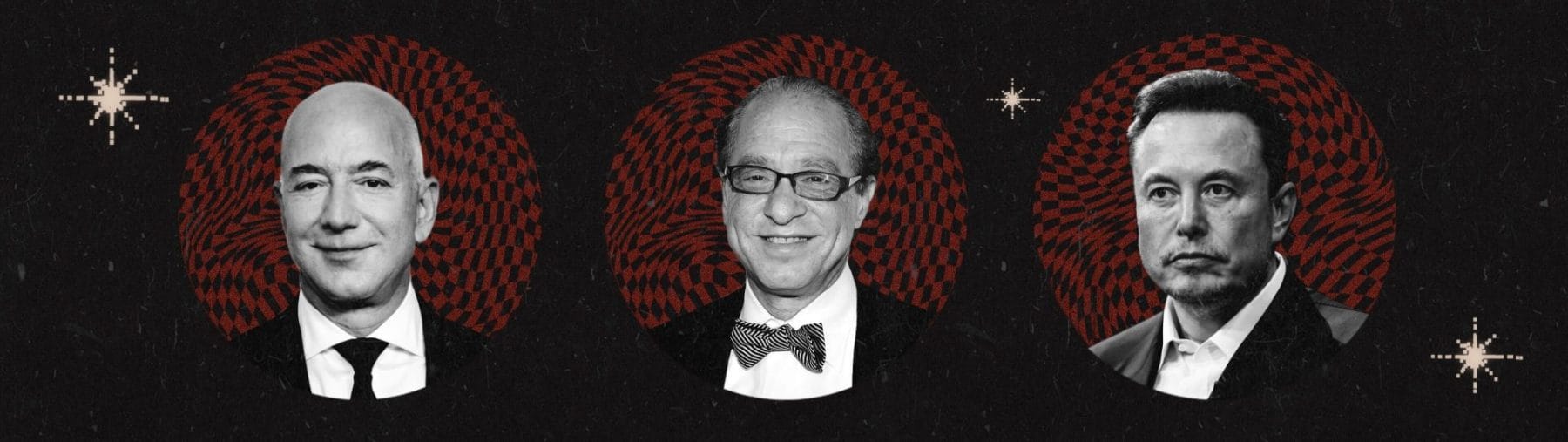
We’ll live in Utopia*
Believers: Jeff Bezos, Ray Kurzweil, Elon Musk
Tech leaders like Jeff Bezos and Ray Kurzweil promise us a solved world. They say that with the help of AI, we can hack our way back into paradise. Some talk about it as “the Singularity” — a world where AI is billions of times more intelligent than humans — and say we just won’t be able to predict or even conceive of what the future will look like once we build artificial intelligence that powerful. But the most optimistic tech evangelists believe it will be a kind of heaven.
“It is a renaissance; it is a golden age. We are now solving problems with machine learning and artificial intelligence that were in the realm of science fiction for the last several decades,” says Amazon CEO Jeff Bezos. “By the time we get to the 2040s, we’ll be able to multiply human intelligence a billionfold. That will be a profound change that’s singular in nature,” adds computer scientist Ray Kurzweil, who has written extensively on the Singularity.
In our podcast Captured, tech workers described what their utopia might look like from their San Francisco condos: “I see a city filled with gardens, filled with communities, a place where people can raise their kids together, a place where people can find a place to belong. And maybe there’s sci-fi elements to that,” engineering physicist Andrew Cote told us, staring out over the horizon.
The catch: But once everything is solved, what will we do with our time? Philosopher Nick Bostrom asks us to imagine what Utopia would actually look like — and whether it’s something we actually want: “Imagine we have all this technological abundance, and we’ve somehow managed not to use it to oppress one another or wage war, but have some reasonably good arrangement. What would human lives be like?” Well, for one thing…

We’ll live forever*
Believers: Bryan Johnson, Peter Thiel
Talk to anyone in Silicon Valley right now and they’ll wax lyrical about ways to live forever. At present, they accept it’s medically impossible — but they believe the day is coming when technology will let us transcend our bodies.
“I’m basically a brain with limbs… the rest is kind of undifferentiated,” said AI builder Kyle Morris when speaking to us for Captured, showing us the vast range of supplements he took to live long enough to see a technological shift where we’ll be able to merge with machines and continue to consciously live beyond the limits of our bodies. Bryan Johnson, tech CEO and leader of the “don’t die” movement, has experimented with injecting his son’s blood plasma into his veins in a bid to live longer — though he says it didn’t really work.
The catch: *Not everyone will live forever. Only those who can afford it. “I suspect we’re going to see a class divide between people who can live hundreds of years and people who live less than 50. That’s going to be a civil war of some sort, I would anticipate,” Kyle Morris told us.
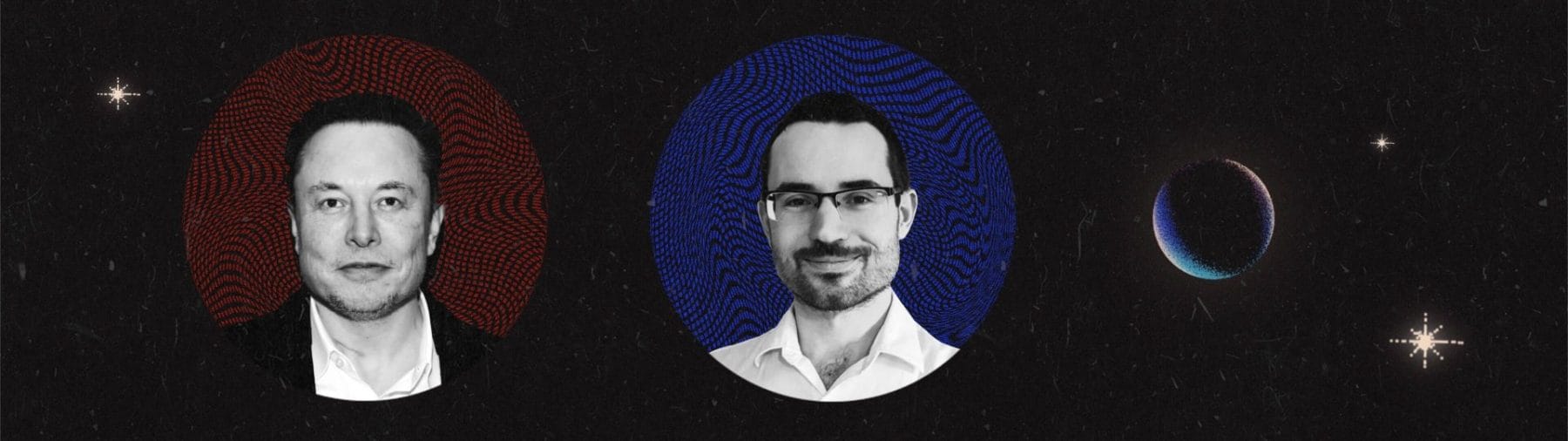
We’re all going to die*
Believers: Elon Musk, Daniel Kokotajlo, Effective Altruists
This might seem contradictory, but in San Francisco it makes sense: there are two camps — those who believe AI will allow us to live forever, and those who believe it will kill us all. There’s also people who believe both outcomes are a possibility. Elon Musk, for example, says there’s “only a 20% chance of annihilation” by super-powerful artificial intelligence programs.
While reporting for Captured, we spoke to Effective Altruists protesting outside Meta: “Pause AI because we don’t want to die!” they chanted. Earlier this year, a group of AI researchers released AI2027, a piece of science fiction charting the rise of runaway artificial intelligence, ending in a brutal showdown where every human is killed by an AI-activated biological weapon, and the Earth is terraformed by datacenters, laboratories, and particle colliders.
*Except the tech-bro survivalists. Tech enthusiasts — with money — believe their inventions could trigger a catastrophic event on Earth: a global pandemic, climate breakdown, nuclear war, or AI apocalypse. They’re quietly prepping. Some are building bunkers in Montana. Others see New Zealand as the ideal bolthole. Peter Thiel has constructed a fortified estate there, designed as a survival outpost.
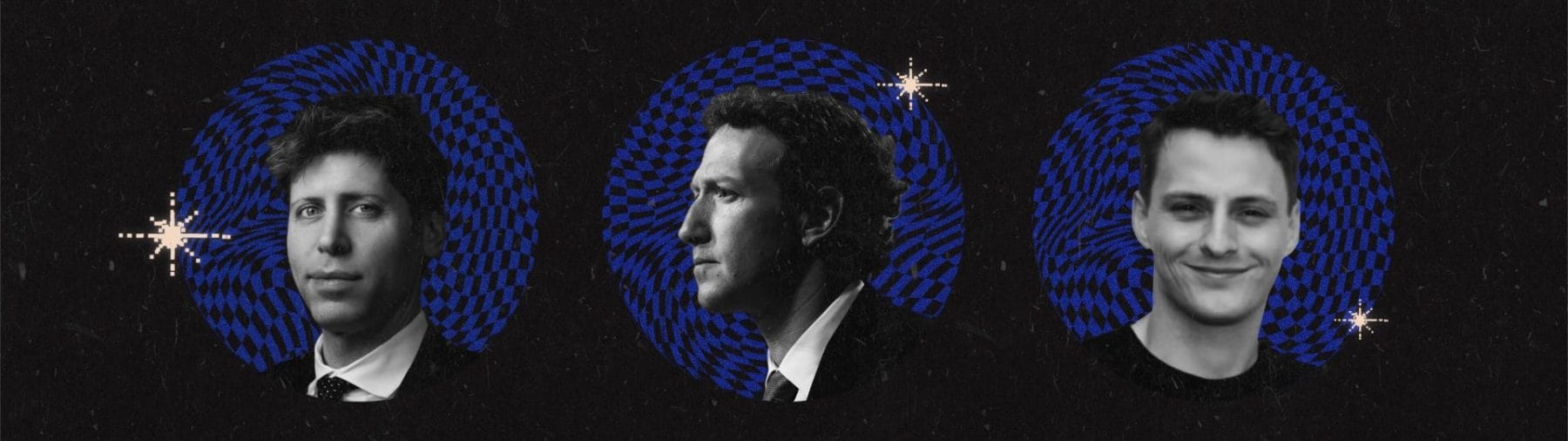
We’ll never have to work again*
Believers: Sam Altman, Mark Zuckerberg, Alex Blania
Tech leaders building artificial intelligence talk openly about how they’re transforming the entire economy. They tell us that the world of work, as we know it, may not exist for much longer. “Entire classes of jobs will go away and not come back,” is how OpenAI CEO Sam Altman puts it. Jobs as we know it will change forever. For Captured, we spoke to nurses who are already seeing chunks of their jobs taken over by artificial intelligence, and even a comedian who worries a day will come when AI starts writing her peers’ jokes. Already, entire industries are feeling the effects of AI takeover. But if we don’t have to work, how will we get paid? Silicon Valley has an answer for that too: Universal Basic Income, an old idea retrofitted for the AI age. The idea with UBI, is that we’ll all get an allowance, a regular payment, no strings attached. That payment will replace income that would previously have come from a job. We traveled to Kenya to look at the prototype for one of these systems in action: a concept called World, that gives you a monthly allowance of around $50. In return, you must submit your iris biometrics to World’s database via a camera device called the Orb. When the Orb arrived in Kenya, there were enormous, chaotic queues at shopping malls, packed with people vying to submit their iris data and get onto World’s system and get hold of the handouts.
The catch: Universal Basic Income sounds great in principle, but if you think deeper, it will completely change what it means to be human. If we don’t work, don’t pay taxes, then we as humans will no longer contribute to society and the economy. We’ll then become completely reliant on — and powerless against — the whims and wishes of those in power, with no way to protest, or strike, if they’re unhappy with how things are going. If we accept Silicon Valley’s vision of the future where we depend on handouts from our tech overlords, we’d concede our freedom, independence and autonomy to a new set of masters. Beyond that, it’s difficult to imagine what we would do all day — as a species — if we didn’t have to work. “If there’s nothing we need to do–if we could just press a button and have everything done, like, then what do we do all day long? What gives meaning to our lives?” philosopher Nick Bostrom mused while speaking to us for Captured.
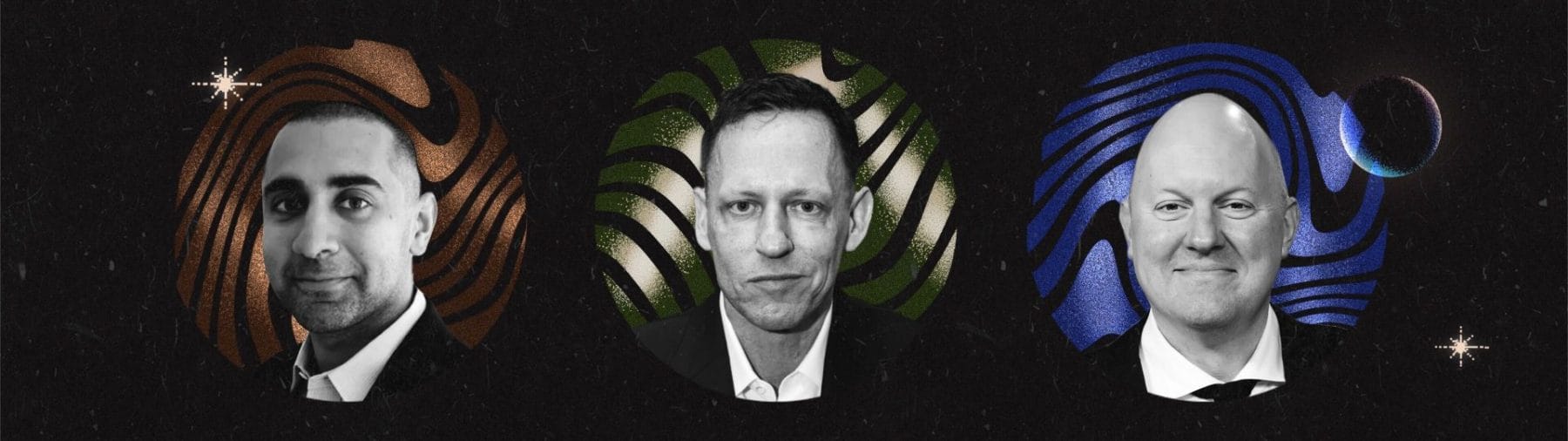
Nation states will not exist*
Believers: Balaji Srinivasan, Peter Thiel, Marc Andreessen
“Very few institutions that predated the internet will survive the internet,” Balaji Srinivasan, the former CTO of Coinbase, said in a lecture recently–and by that, he means governments, and countries themselves. After all, governments come with a whole host of irritating traits that tech leaders loathe–they regulate companies, make them pay taxes, tell them what they can and can’t do. Why not secede, then, from those countries entirely, and build your own? Srinivasan is one of the leading thinkers behind the idea of a “networked state” — a successor to the nation state, built and enabled by tech.
Proponents of the networked state dream of having digital statehoods; “startup nations” where they’ll be free of taxes and regulations, free of the bureaucracy of living in, well, a traditional country. They’re already doing it: pushing to draft legislation to create “freedom cities” in the U.S. — something Trump’s 2024 campaign proposed, enclaves unshackled by federal law where tech engineers can try out startups and clinical trials free from regulation or approval from federal agencies. Meanwhile on an island off the coast of Honduras is Prospera, a semi-autonomous “private city” backed by Sam Altman, Marc Andreessen and Peter Thiel, that’s marketed as a libertarian fantasy utopia.
The catch: The idea of getting rid of stifling government bureaucracy and living in a world without borders is an idealistic dream held by many people, not just tech leaders. But, as the Silicon Valley elite envisions it, we would replace sovereign nations with a collection of private, giant gated communities that would hoard resources, money, and power, while locking everyone else out. A world where democracies no longer exist and elected leaders are replaced by digital moguls would be a world that serves clients, not citizens, and cares only for profit and innovation, a world where international human rights laws are thrown out.
We’ll spread out into the stars*
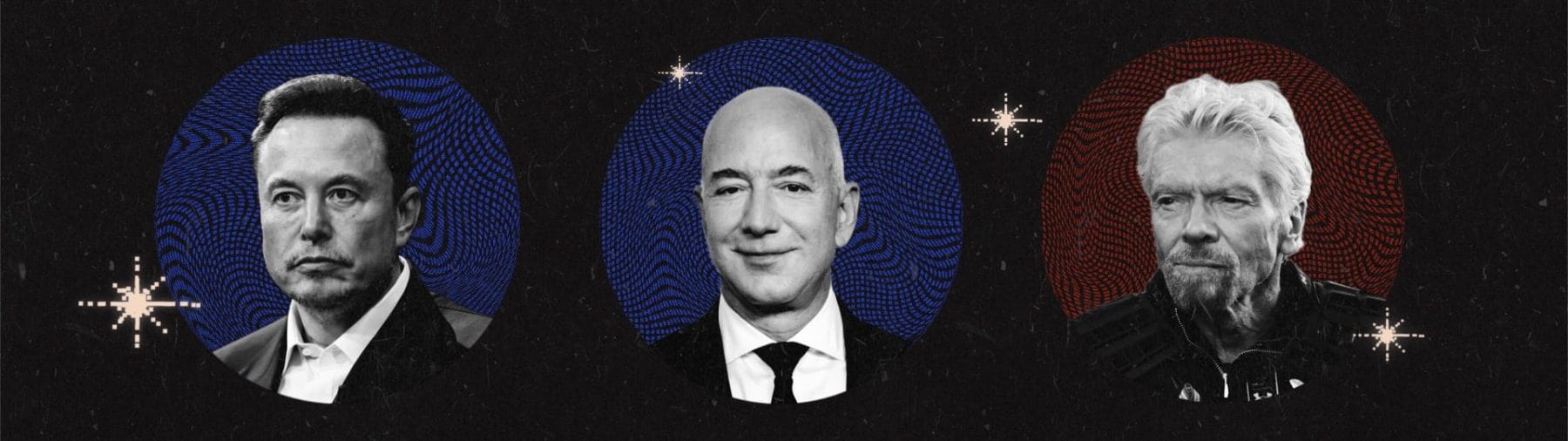
Believers: Elon Musk, Jeff Bezos, Richard Branson
But what if we could take this idea of building crypto-states further — and leave Earth entirely to build Silicon Valley outposts on Mars, or on the moons of Jupiter? Not only transcend our bodies, but transcend the Earth itself — after all, if we can’t fix the planet, we can just leave it. Jeff Bezos talks about moving “all polluting industry into space” and leaving Earth as a nature reserve — one of the tech industry’s many technofixes for climate change. And all of Elon Musk’s ventures, from Tesla to X, are designed to support his ultimate mission: making the human species “multiplanetary.”
“They want to ensure the light of consciousness persists by reducing the probability of human extinction,” says Émile P. Torres, a philosopher who used to be part of what they call the emergent “cult” of Silicon Valley. Torres told us about the tech bros’ vision of a utopian future where humans conquer the universe and plunder the cosmos. It sounds like something out of science fiction — and indeed it is: when we visited AI frat houses during our reporting for Captured we found bookshelves stuffed with science fiction about space and colonizing the universe.
Harvard historian Jill Lepore has a different way of seeing it — she calls it “extra-terrestrial capitalism,” mimicking a colonialist vision of expanding indefinitely, taking our extractivist mindset into the stars.
The catch: Not everyone will be able to travel into space — or perhaps, not everyone will be able to stay on Earth. If you read enough sci-fi, and listen to enough conversations in Silicon Valley, you can envision all sorts of different outcomes: Mars becoming a penal colony filled with slave workers extracting resources; Mars becoming independent from Earth; only the super-rich and elite able to leave Earth as the planet burns. In Musk and other tech-bro survivalist visions of the future, they imagine a global pandemic, climate meltdown or nuclear war extinction event — perhaps thanks to the runaway Artificial Intelligence they themselves built — and see space as the ultimate off-ramp for a chosen few.
“It’s important to get a self‐sustaining base on Mars… because it’s far enough away from Earth that it’s more likely to survive than a moon base,” Musk told the audience at South By Southwest in 2018. “In the hopefully unlikely event that something terrible happens to Earth, there’s a continuance of consciousness on Mars. One of the benefits of Mars is life insurance for life collectively,” he said this year.
We’ll have all human knowledge in our brains*
Evangelists: Elon Musk, Bryan Johnson
Why bother with school when you could install a chip in your brain? Right now, tech leaders are working on building chips — like Musk’s venture, Neuralink — that we can insert in our brains, so that one day, we can merge with machines. When we met engineers in San Francisco, they told us about their ultimate ambition: to put all human knowledge inside human brains, from birth.
“That’s the purpose of the education system, right?” said Jeremy Nixon, the founder of AGI House, which brings together AI workers into a houseshare in San Francisco.
But why not skip over all that and simply install a chip into our brains, so that even from birth we can know everything, all at once. Imagine, we’ll be able to speak every language on Earth, we’ll know all of human history, all of science. Ok, we might not be able to discover anything new — but our future will be boundless. “You hold your phone and it’s like a better prefrontal cortex. It tells you how to get places, tells you how to plan. It gives you answers. It gives you a better memory. I see in the next 50 years, that’s going to enter us, that’s going to become part of us,” Kyle Morris, another member of the AGI House, told us.
The catch: Not everyone will necessarily be able to get this supersonic brain — and those enhancements will only come to those who pay. So, as tech leaders see it, could there one day be an underclass of people who can’t afford — or don’t want to install — these brain enhancements? And will those with enhanced brains then oppress those without them? Just as the world is becoming harder and harder to navigate now without a smartphone, perhaps in the future it will become harder to navigate without a chip in your brain — will you be able to travel, move freely, do simple errands? Last week, Mark Zuckerberg said that people without smart glasses like Meta’s model, that give them instant and constant access to an AI assistant, will be at a cognitive disadvantage.
Climate change will be fixed by tech*
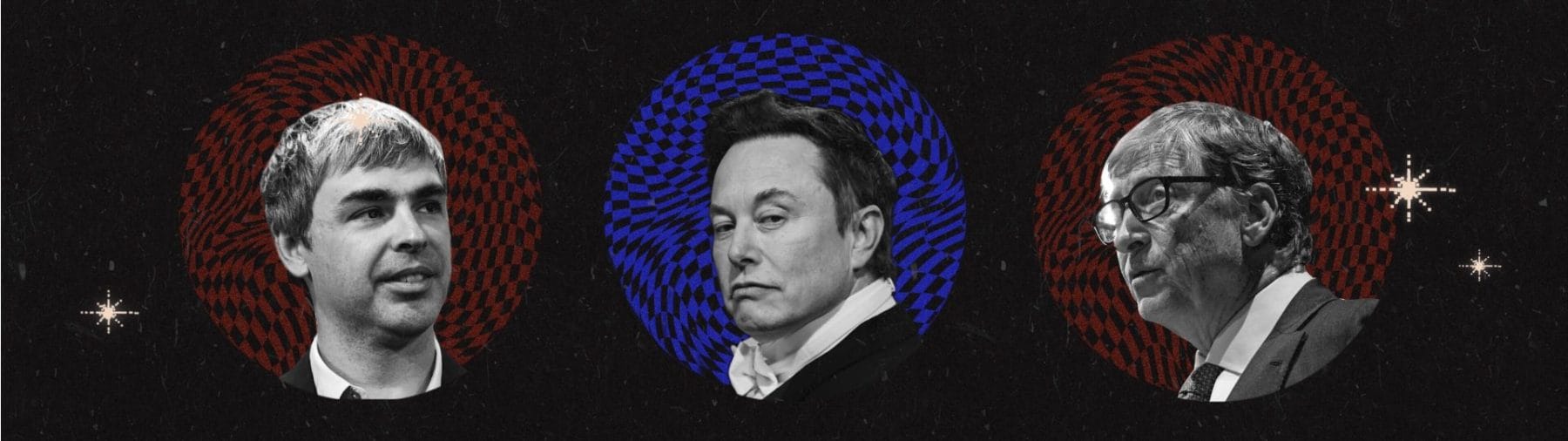
Evangelists: Larry Page, Elon Musk, Bill Gates
Related Articles


There’s an idea we came across while reporting in Silicon Valley that climate change, while problematic, is nothing much to worry about, because one day soon it too, like everything else, will be fixed by some technological intervention. Perhaps we’ll geoengineer the skies to create “sunscreen for the Earth” (as one pair of tech evangelists-turned-guerilla geoengineers dubbed it); perhaps we’ll finally figure out nuclear fusion (that’s a favourite prediction in Silicon Valley circles), or we’ll figure out how to get our oceans to sequester carbon. In November, Elon Musk proposed that “A large solar-powered AI satellite constellation would be able to prevent global warming by making tiny adjustments in how much solar energy reached Earth.” Though artificial intelligence datacenters suck up vast quantities of water and spew carbon into the atmosphere (Google’s newest datacentre in the UK will emit 570,000 tonnes of CO2 a year, according to planning documents), the tech leaders tell us: we’ll figure out the answers sooner or later; or AI will do it for us.
The catch: Geoengineering, while a favorite pipedream of tech enthusiasts, could have unpredictable, and Earth-shattering consequences. Climate experts say processes like these could throw Earth into deeper chaos by cooling the world unevenly and wreaking havoc on our climate systems. And once we start the process of solar geoengineering, we won’t be able to stop — we’ll have to keep spewing chemicals into the atmosphere to cool down the sun, or face a rapid and catastrophic heating event. Who would even be in charge of geoengineering the planet; and who would decide if it was safe enough?