



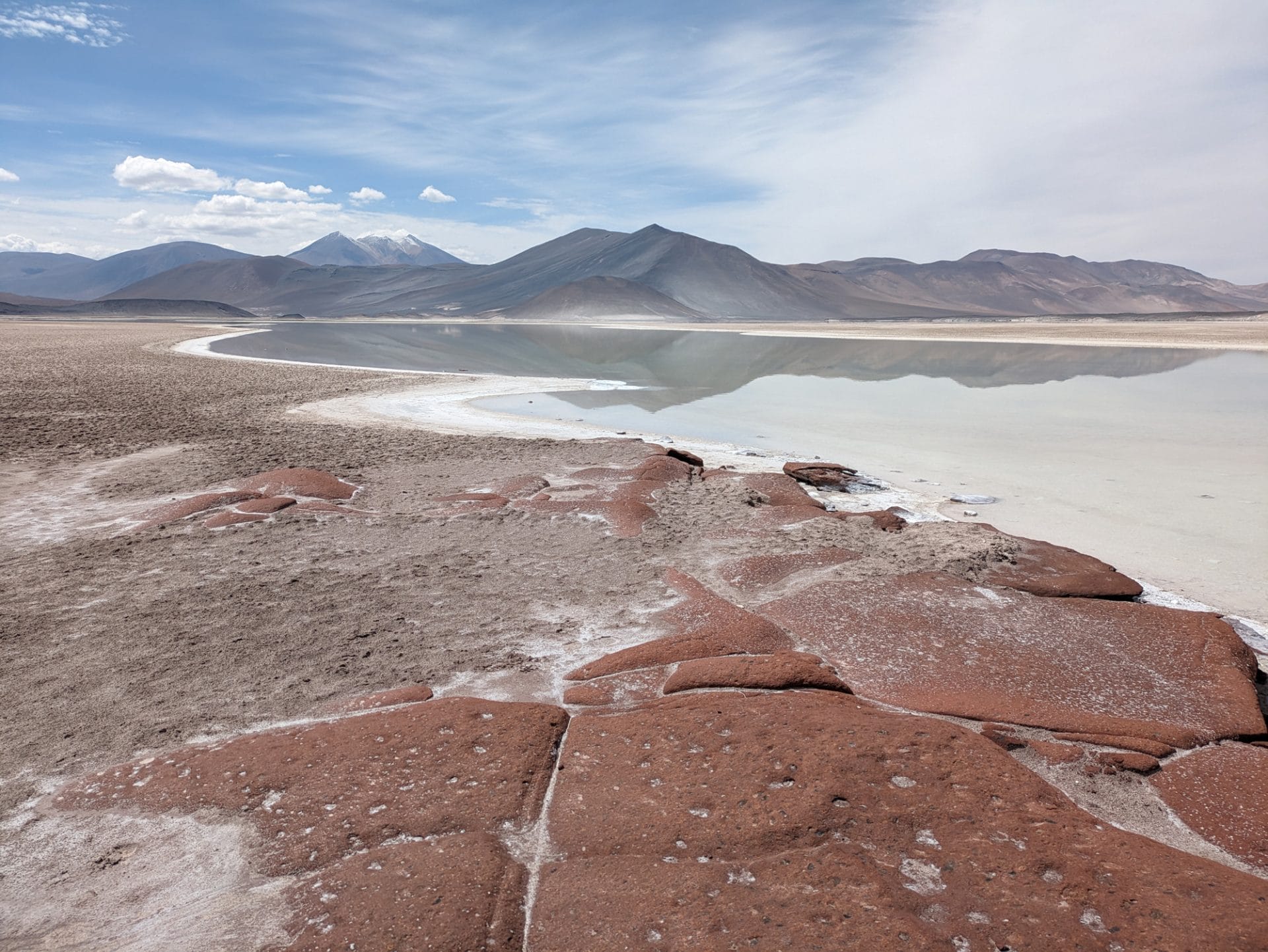
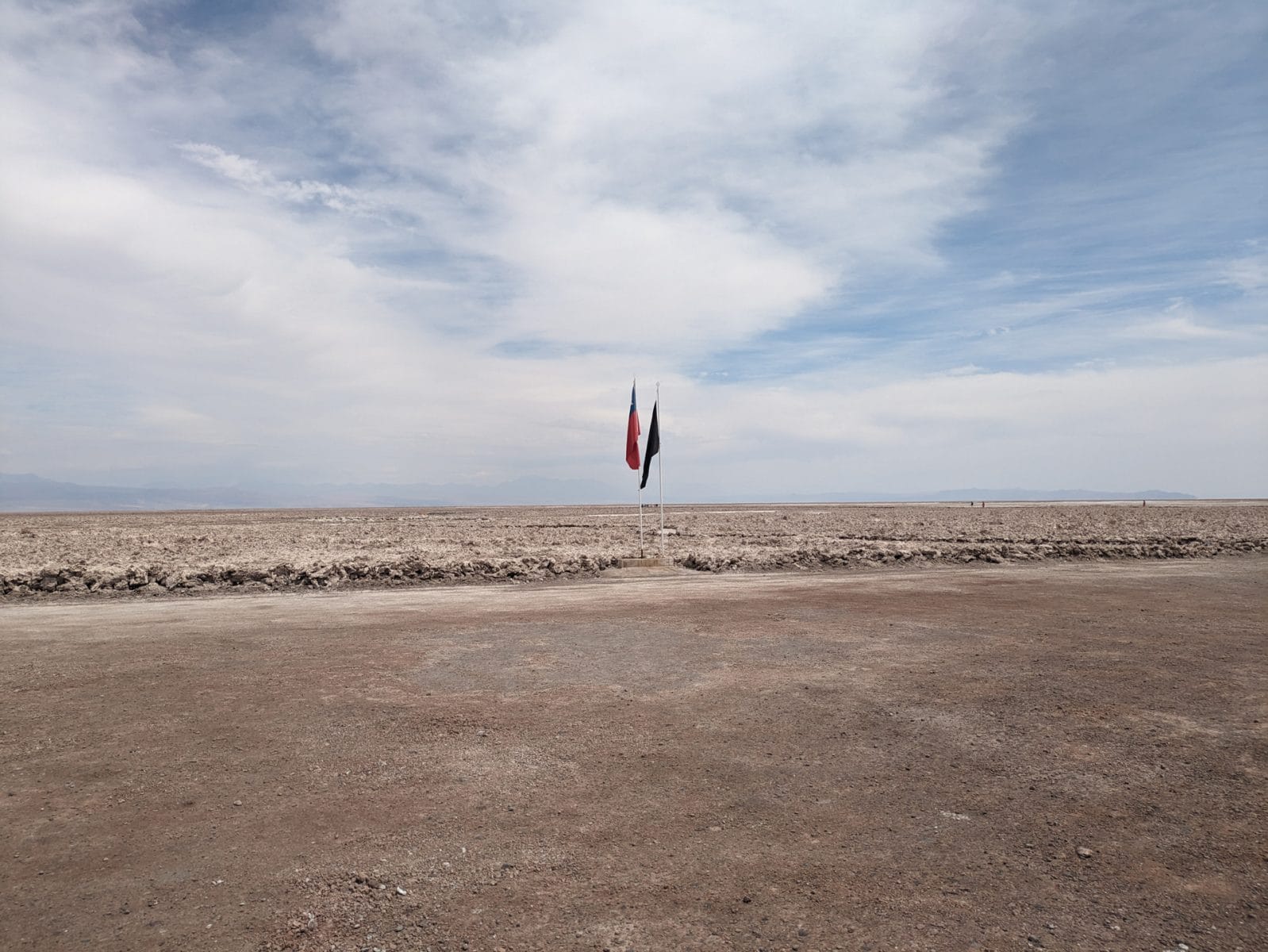
After kilometers of flat, orange desert, the bus dives down through an increasingly lunar landscape as it reaches San Pedro de Atacama. Amidst the sea of red rocks, patchy vegetation and distant high plains known as altiplanos, a small sign appears on the side of the road. The entry marker has been tagged in graffiti. “Se vendió los salares.” “They sold the salt flats.”
The town of San Pedro, located in the north of Chile not far from the borders with Argentina and Bolivia, then appears like an oasis. In this hub for international tourism, small buses packed with visitors make trips from the dusty, bustling center to explore the region’s various geysers, sand dunes and volcanoes. Night sky tourism ventures offer a unique look at the southern stars. But it is the vast white salt flats, formed between 100 and 10 million years ago, that people come from around the world to see.
As tectonic plates slowly shifted, water flowing from the Andes mountains lost access to the sea and settled into a natural drainage area known as an endorheic basin. Here, water evaporated quickly, leaving a white crust of salt on top and below, a rich mélange of minerals – lithium, potassium, magnesium, and boron — encased in brine. The Salar de Atacama is one of the biggest salt flats in the world — and one of the most important.
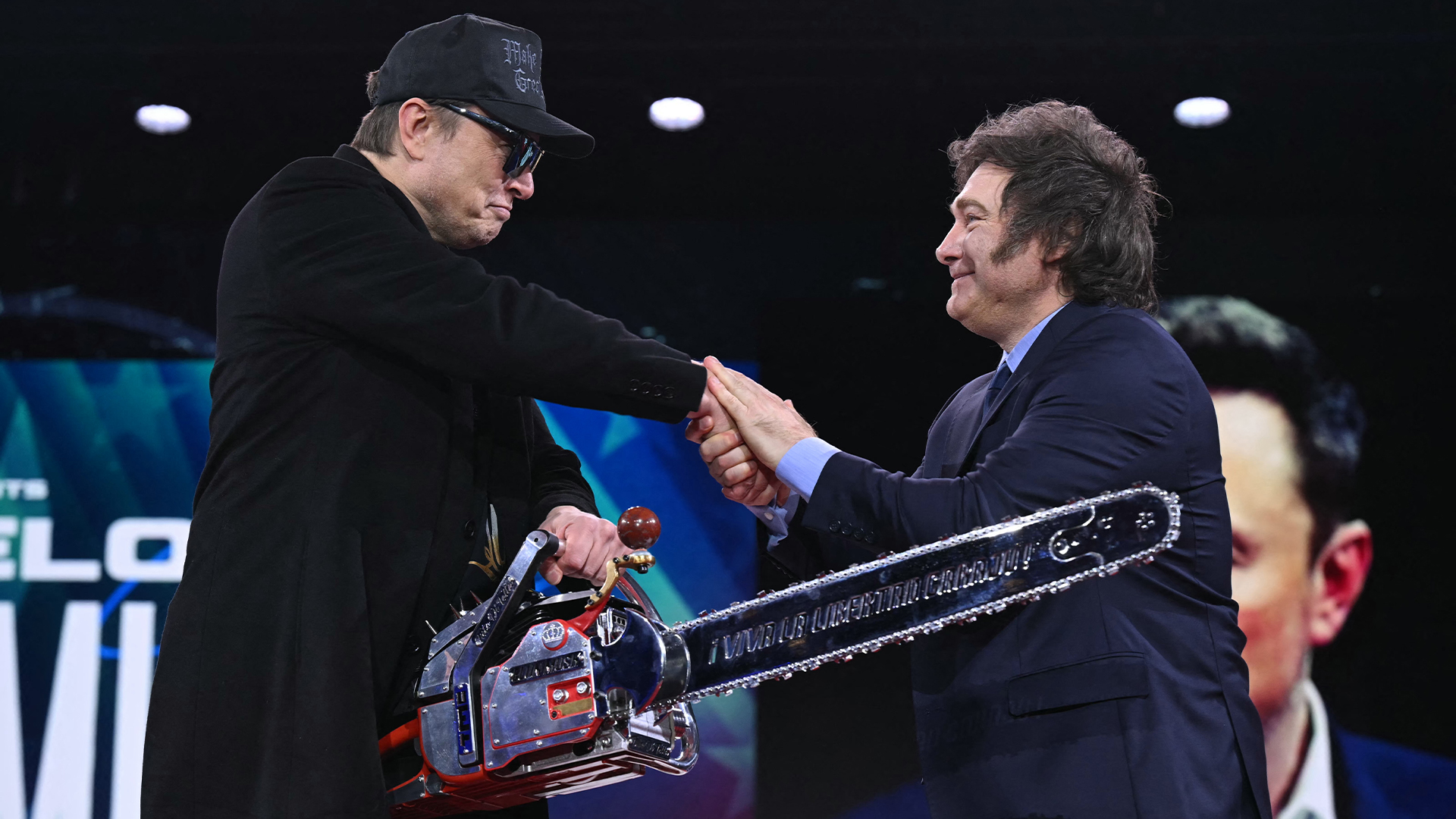
On March 11, Jose Antonio Kast, Chile’s new president took office. Kast, a conservative ostentatiously close to Donald Trump, has long been a critic of Chile’s national lithium strategy. One of his first actions as president was to sign an exploratory deal with the United States to extract rare earths and essential mirals. Chile, the world’s largest producer of copper and second largest of lithium, is central to the Trump administration’s plans to reduce its reliance on China as a source of the rare earths and metals that are fundamental to modern industry, from semiconductors to electric vehicles to batteries to defense technology.
Even before Kast took office, he attended Trump’s “Shield of the Americas” summit in Miami, an ostensibly security-related alliance that is also an attempt led by the U.S. to curb China’s growing influence in Latin America. Under the previous Chilean government, China had become a dominant player in the national lithium industry, as it had in Argentina. With Javier Milei, a Trump ally, in office in Buenos Aires, having another ally ensconced in Santiago has been a significant boost to U.S. plans to reclaim its role as the overwhelming regional hegemon. It was intervention from Washington, for instance, that led to Chile abandoning a $500 million Chinese telecom deal to link the two countries via undersea fiber optic cables.
Amidst the geopolitical wrangling, though, is the question of who benefits from Chile’s national resources and what impact the relentless drive to extract those resources has on the country and its people.
Sonia Ramos Chocobar sweeps kibble from the small kitchen table of her home on the outskirts of San Pedro and shoos her five dogs and three cats into the yard. Chocobar has just returned home after several days in neighboring Calama – where she was attending the first-ever Salt Flats Conference – and the house is a mess. The climate activist has made time between her afternoon grocery shopping and an evening community gathering to meet with me.

Chocobar, in her 70s, is a bit of a local legend. In 2009, she made national news when she and another environmental activist (Amelia Mamani, since deceased) silently walked from San Pedro to Santiago, a distance of 1,534 kilometers, to raise awareness about the environmental risks of geothermal exploration near a geyser known as El Tatio — sacred to the Lickanantay indigenous community she comes from. The “march of the grandmothers” was followed by other environmental actions. Most recently, Chocobar walked to Antofagasta, the gritty port town that exports much of the copper, lithium and other resources mined out of the vast expanses of land in what’s known as Chile’s Gran Norte (“Greater North”) region.
This time her message was different: save the Atacama salt flats.
The broader area where the borders of Chile, Argentina and Bolivia converge is often referred to as the world’s “lithium triangle.” This lost corner of South America is believed to hold 68% of the world’s lithium reserves — a key element in the production of the lithium-ion batteries that fuel not only electric vehicles, but, increasingly, data centers and other large “green” infrastructure projects. San Pedro, roughly in the middle of the triangle, is sitting on a modern gold mine — and a faultline for the future of renewable energy.
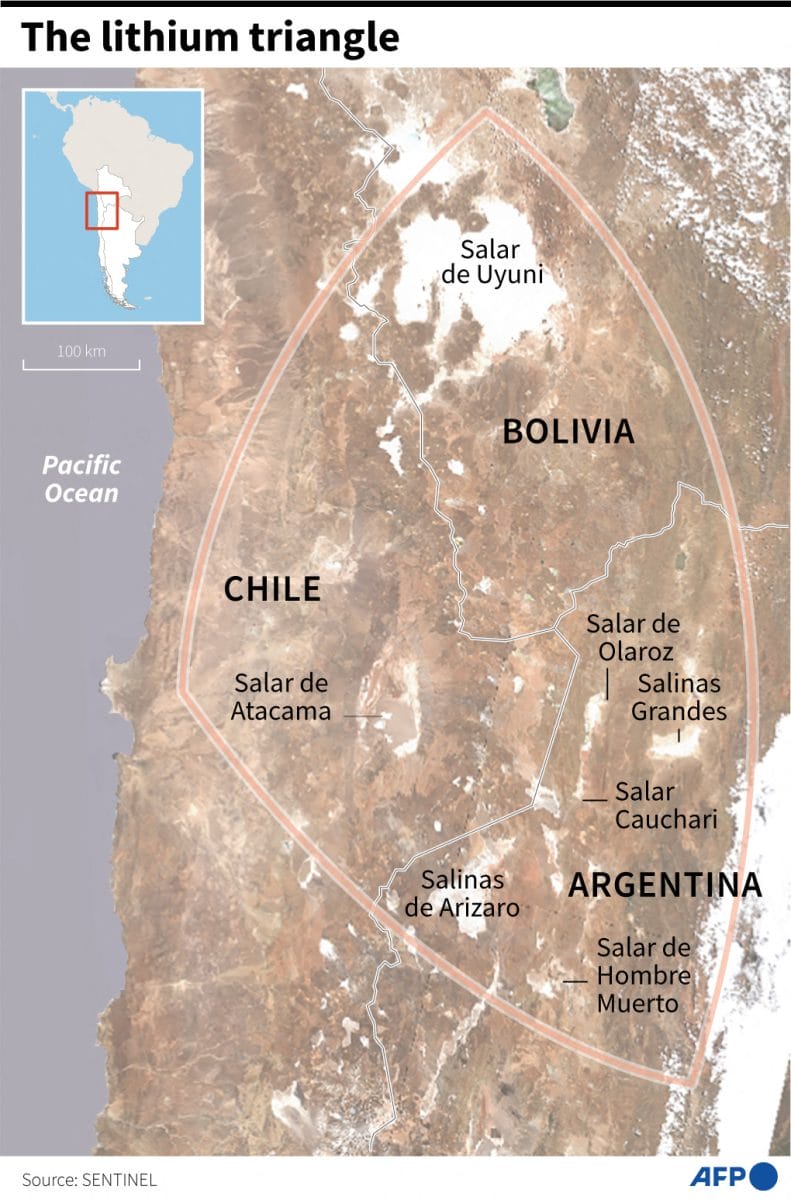
The town of 2,500 full-time residents has long been at the center of a tug-of-war between different actors, all of whom claim sovereignty – dominion – over the salt flats surrounding it: the indigenous communities who have called this environment home for centuries, the Chilean state and the international markets salivating over the “white gold” extracted from it. Over the years, and through much negotiation on local, national and international levels, a sort of entente had been reached: the state owns the resource, private companies exploit it and some of the profits kick back to local communities. Lithium was even granted a special status under a dictatorship-era decree: a “strategic” mineral, only to be mined with the express agreement of the State. The election of Kast has already disrupted this tenuous equilibrium. The Chilean president has removed environmental protections from roughly 40 different types of natural resources — reopening the tap that has long fueled extractivism and inequality in Chile after four years of left-wing, protectionist policies.
With counter space cleared and the tape recorder set, Chocobar begins to speak, choosing her words carefully and pausing regularly for emphasis. She sounds tired, but steely. “We are always in a constant effort to protect our water, our land,” she tells me. “We have the misfortune of the Pacific. And we have the misfortune that the Salar de Atacama is one of the greatest lithium sources in the world.”
It wasn’t always this way — in fact, the “resource curse” is relatively new, she explains. For a long time, the Atacama desert was viewed by most Chileans as a no man’s land. Growing up as a member of the Lickanantay indigenous community — also known as the Atacameño people — Chocobar learned how to coexist with the harsh environment, rather than to dominate it. How to extract groundwater, which plants to grow, when and where to shuffle crops. “If we are millenary people, it is because we have found many ways to survive here,” she says. “People think the desert is lifeless, but it’s the exact opposite.”
Over her many years, Chocobar has seen these techniques slowly disappear: dried-up streams, dying flora and fauna, water rerouted from communities to corporations. The natural richness of the desert lands she calls home has been converted into a monocrop for export. The culprit? The world’s increasingly rapacious appetite for rare earths and metals.
Lithium demands huge amounts of water. To extract the resource through a process called brine evaporation, mineral-rich groundwater is pumped from beneath the salt flats at a rate of thousands of liters per second into vast open-air ponds. Then, the water is evaporated to reveal the lithium. 95% of this groundwater — which once belonged to the smattering of 18 indigenous communities that inhabit the region — quite literally disappears into thin air.
For local communities, the strain is already noticeable. In San Pedro, an estimated 49% of residents don’t have access to running water, says journalist Ernesto Picco. In one town — the ironically named Santiago del Rio Grande — Picco has reported, 100% of residents have no access to water.
It’s not only humans who are being affected. The water scarcity has modified the breeding and feeding habits of alpaca populations, a local llama herder in neighboring Toconao, Hugo Flores, told me. A river used to run through San Pedro. On one of my days in town, I climbed down a ladder and walked across the dried up stream to get a better view of the distant Licancabur Volcano. The caked ground chipped under my sandals.
“We’re sitting on a watershed, and yet there is water scarcity,” Chocobar explains. “We’re being conquered, in a sense — commercially, economically. It is a natural laboratory that is being destroyed.”
Lithium hasn’t always been so coveted.
When it comes to minerals, in Chile, copper was for a long time — and still is, to a certain extent —king. Since its discovery in the 1880s, the South American country has been one of the world’s largest exporters of copper, which is drilled out of open pit mines in the Gran Norte region. From the window of a taxi in the port city of Antofagasta the day before, I had admired the massive telescopic loading chutes that transport the mineral directly into the hull of boats, releasing brown-gold particles into the air that settles on surfaces — park benches, balconies, cars — across the city.
It wasn’t until the 1960s that the Chilean government began to recognize the benefits of lithium after accidentally discovering it buried in salt brine during an exploration aimed at identifying additional water sources for copper mining. The timing couldn’t have been better. “After World War II, there was a lot of speculative value in lithium as a nuclear material,” James J. A. Blair, a professor at Cal Poly Pomona who has published several papers on lithium mining in Chile, explained over a recent video call.
In 1979, about six years into his 17-year iron reign and following the lead of the United States, which had done the same, Chilean dictator Augusto Pinochet declared lithium a “strategic resource” reserved exclusively for the state — not on account of its economic potential, which was at the time unknown, but as a national security stockpile.
This seemingly small linguistic tweak has had long-lasting effects.
After Pinochet’s decree, lithium extraction came under the auspices of Chile’s State Development Agency, CORFO, which started to ink contracts with private firms for further exploration. A year later, CORFO partnered with U.S.-based Foote Minerals to form the Chilean Lithium Company (SCL), in which the state held a 45% stake.
What began as a Cold War precaution would quietly harden into one of the most unusual resource regimes in the world. By carving lithium out from the standard mining code, written in the 1930s, the Chilean state created a hybrid model. Lithium was not exactly nationalized, but neither was it fully privatized. “Lithium sits in a legal gray zone in Chile,” Blair told me. “It’s formally non-concessionable — meaning private actors can’t just stake a claim the way they would for copper — but in practice, the state has delegated extraction through long-term agreements that are incredibly favorable to a small number of firms.”
During the dictatorship’s wave of privatizations in the 1980s, control over key lithium assets was transferred to a small circle of politically connected actors. Among them: Julio Ponce Lerou, Pinochet’s son-in-law, who would go on to run SQM, now one of the world’s dominant lithium producers.
“Decisions were made in a highly centralized and opaque way,” researcher Gonzalo Gutiérrez told me over cafeteria food at the University of Chile, in Santiago. “By the time lithium became economically important, the institutional framework was already locked in.”
That framework has proven to be remarkably durable. Even as Chile transitioned back to democracy in the 1990s and expanded its role as a global mining powerhouse, lithium remained an exception — governed not through open concessions but through a handful of contracts administered by CORFO.
In her 2025 book “Extraction,” researcher Thea Riofrancos notes that even today, two firms — SQM and Albemarle — effectively operate as a “a legally sanctioned private duopoly.” Control over lithium, she writes, is a tightrope between “the palpable potential of public control and the reality of corporate dominance.”
For Ramón Balcázar, the founder of the San Pedro-based nonprofit, Fundacion Tantí, this legal exceptionalism has had profound consequences on the ground. “The state claims ownership, but the impacts are local,” he said. “Communities were never meaningfully included in the design of these contracts, yet they are the ones living with the depletion of water and the transformation of their ecosystems.”
Balcazar’s nonprofit sits on a side street in San Pedro, across from a trendy French bakery called La Franchuteria that sells iced lattes at European prices.
Since its founding in 2016, Fundacion Tanti’s small team of researchers has studied the effects of lithium mining on indigenous communities in the Atacama desert. The period has coincided with nothing less than an explosion in the demand for Chilean lithium.
The growth has mostly been tied to a dramatic rise in demand for electric vehicle batteries. Between 2015 and 2024, global lithium demand grew roughly sixfold, largely driven by EV batteries. The boom has fundamentally reshaped lithium markets: whereas EV batteries accounted for only about 15% of lithium demand in 2017, they made up roughly 85% by 2023. In Chile, arguably the world’s lithium breadbasket, raw materials are mined for export but rarely do its benefits trickle back down to communities.
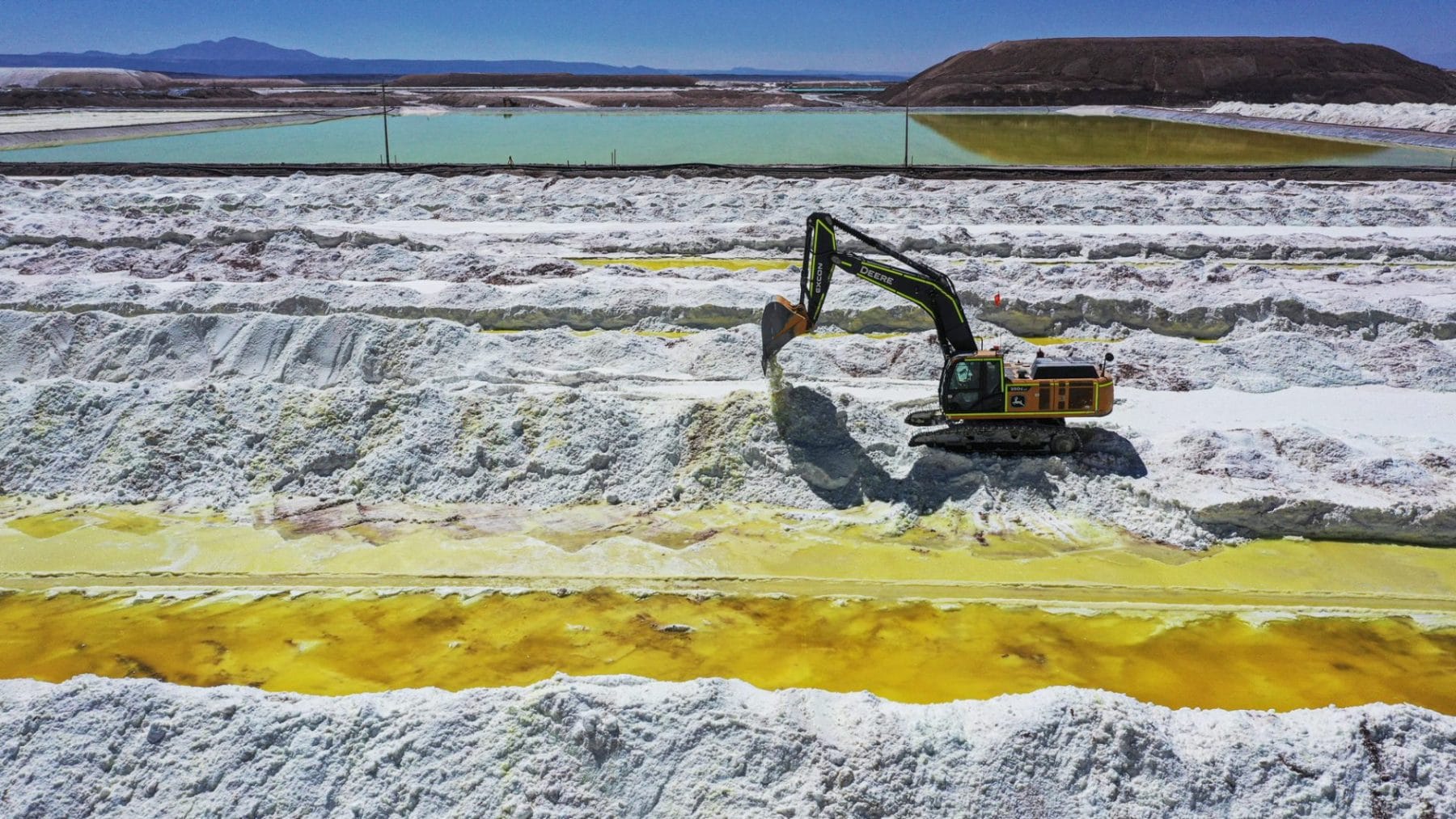
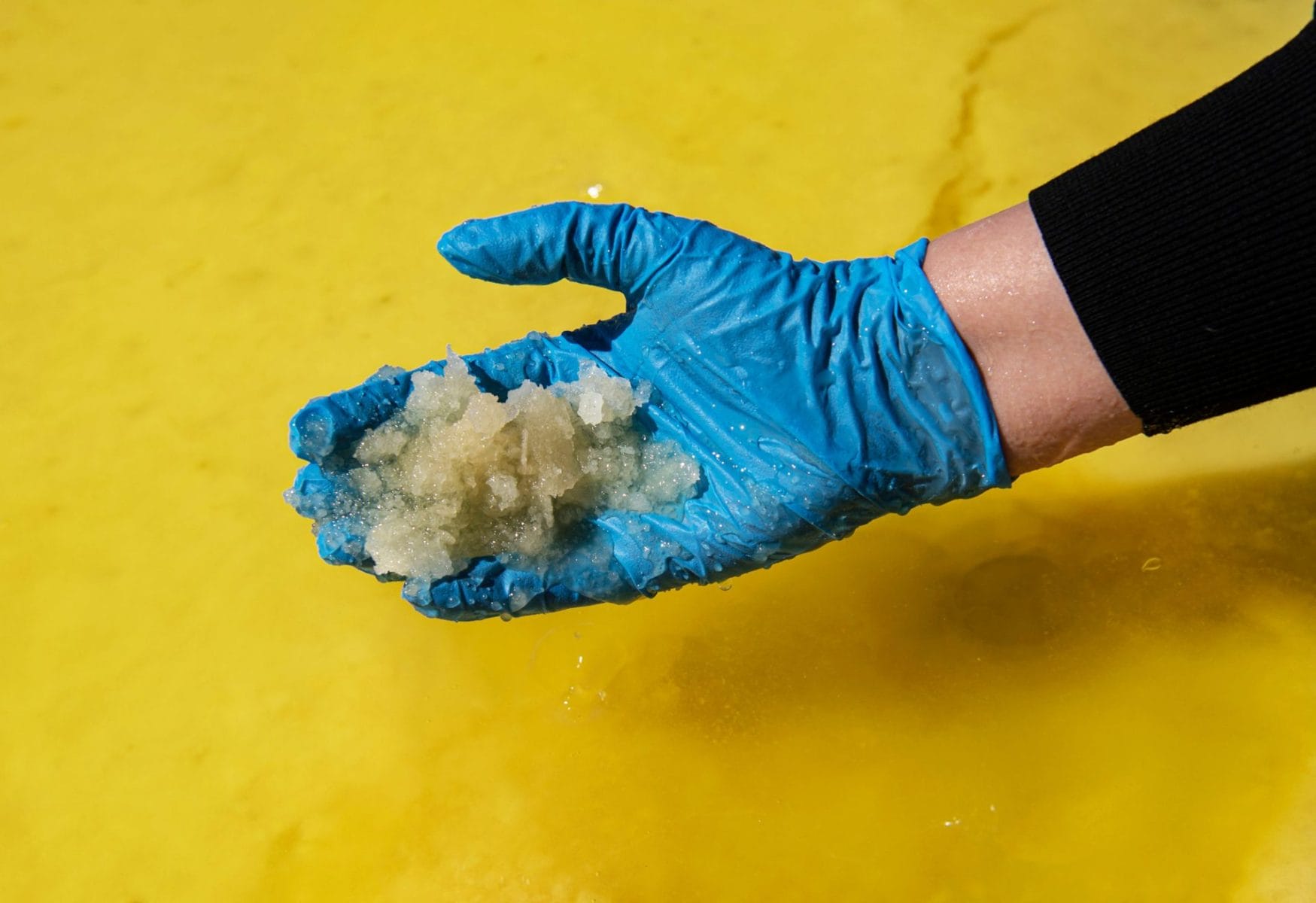
Right: A worker displays 9% lithium from a sample pool at Chilean company SQM’s lithium mine in the Atacama Desert, Calama, Chile. Martin Bernetti/AFP via Getty Images.
“Where is the lithium going? To Elon Musk?” Daniela Rodriguez, a local journalist and activist I spoke with in San Pedro, asked. “To send rockets into space, to power electric cars that you never even see around here?”
In 2021, Balcazar and fellow researchers came up with a neat term for this phenomenon: “green extractivism.” “What we are seeing is not an energy transition — it’s an expansion of the extractive frontier under a green label,” he told me.
Faced with increasing demand for lithium to fuel the “green revolution,” the Chilean state has tried to thread the needle. In 2019, after a wave of mass protests against neoliberal inequality known as “el estallido social” (the social uprising), Chileans elected Gabriel Boric, a young, tattooed reformer who promised to, among other things, reassert state control over the lithium supply chain to redistribute its value.
“Lithium is the mineral of the future,” Boric said on the campaign trail. “Chile can’t make the historic mistake of privatizing resources again.” His government promised a paradigm shift: more community involvement, more protection of wetlands, greener methods of extraction. Lithium, he seemed to say, would benefit Chileans across the whole supply chain and not just a select few at the top.
In April 2023, the government announced its National Lithium Strategy. The policy sought to expand production while increasing state control through public-private partnerships, renegotiate the contract with SQM (the same private company once headed by Pinochet’s son-in-law) and include community and indigenous participation in future lithium exploration decisions.
In all, Boric’s government identified 68 salt flats that could be opened to mining exploration, but also 27 wetlands to be protected, Riofrancos, the author of “Extraction,” notes in her book.
“The national lithium strategy is Boric’s most successful policy,” Nicolas Grau, Boric’s former finance minister, told me over the phone. “It will allow Chile to industrialize through lithium — growing the economy while also protecting the environment.” After years of passive control, the state would finally take a more “protagonistic role” in managing the resource, Grau said, without nationalizing it.
To Riofrancos, the juggling act under Boric was typical of what happens when a state tries to pry some space in a market where extractivism has long been left unchecked. “Boric’s blueprint cited Allende as an inspiration, but his approach was more conciliatory toward extractive capital than anything Allende had proposed,” she writes.
Local communities in San Pedro felt similarly. “The only thing politicians care about is being in power,” Chocobar said in San Pedro. “For all intents and purposes, we might as well not exist.”
Related Articles
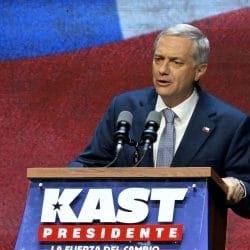
Boric’s successor, Kast has quickly rolled back environmental protections, fulfilling his campaign promises of commercializing mining and partnering with the U.S. regardless of the environmental impacts on the salt flats.
Jorge Heine, a former Chilean diplomat and expert on international relations, argues that Kast is more constrained than it might appear. “People tend to overestimate how much a single administration can reshape lithium policy,” Heine explained. “This is a sector governed by long-term contracts, by international commitments, and by a legal framework that has proven remarkably resilient. Kast can tweak, accelerate, or slow things down, but dismantling the model entirely would come at a significant political and economic cost.”
But huge costs are already being paid, costs that communities in San Pedro have been living with for decades. Could Kast’s attempts to liberalize lithium mining and potentially exacerbate inequalities and environmental damage galvanize resistance?
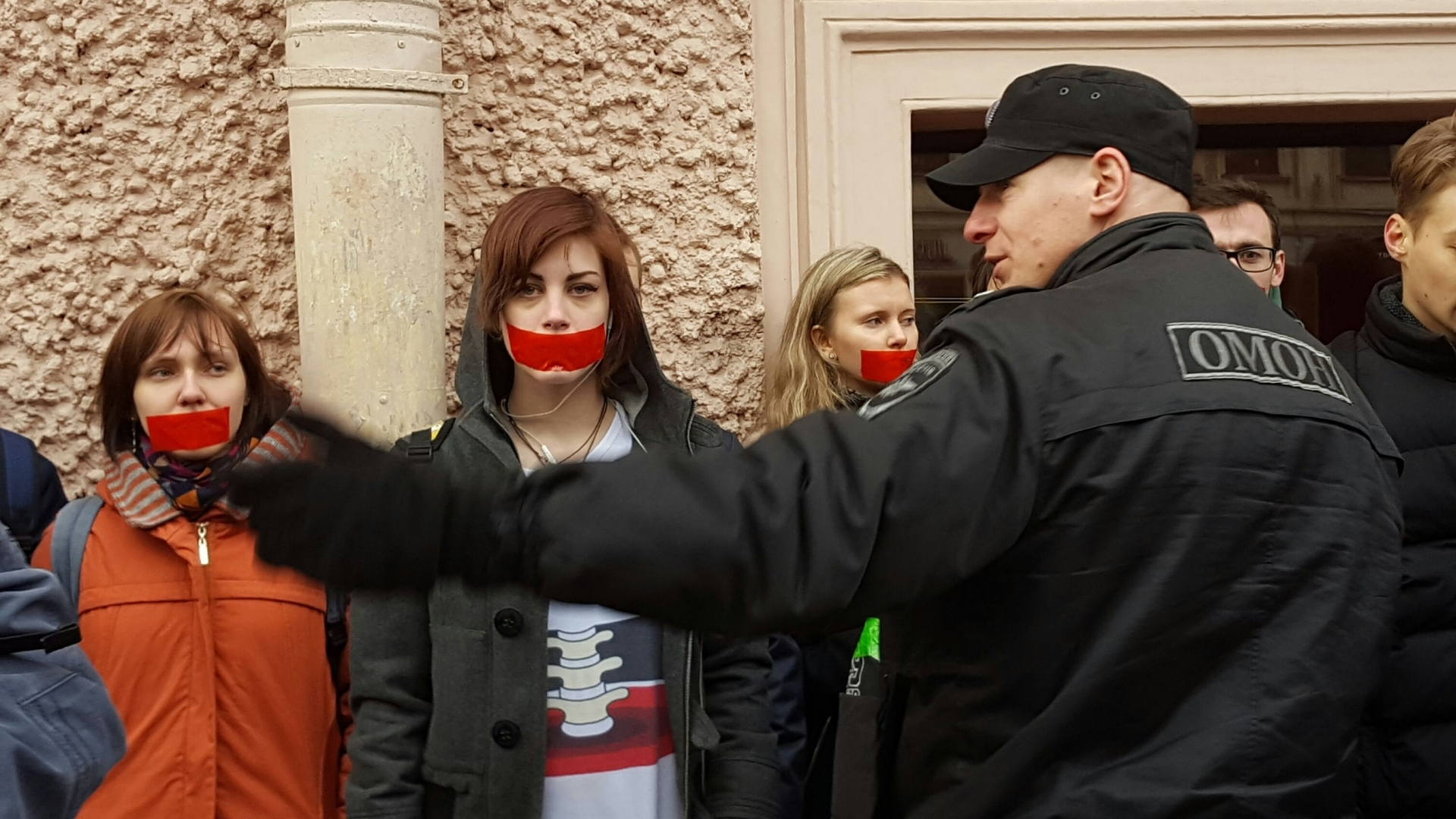
For now, the signs of that resistance are still weak: graffiti scrawled on the side of the road, a grandmother walking along a highway with a cardboard sign, four panels of wood hung in a town square. But like lithium itself, transformations tend to take place very slowly at first — millennia of build-up in the brine — until suddenly they happen very fast. From Santiago to Atacama, protesters have been taking to the streets. In June, broader protests against Kast’s dismantling of social programs and services turned violent.
At some point, austerity for the people contrasted with largesse for mining companies, technology companies and acquisitive foreign powers becomes hard for even a government elected in a landslide to defend.