






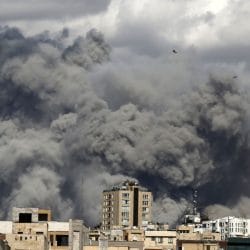
As the Iran war pushes oil prices over $100 a barrel, and ships are attacked and mines are being laid in the Strait of Hormuz, a taboo has been broken and nuclear energy is back in fashion. European Commission president Ursula von der Leyen acknowledged that “the current Middle East crisis is a stark reminder” that it was “a strategic mistake for Europe to turn its back on” nuclear energy.
She was speaking at an International Atomic Agency summit hosted by France. Just days before the summit, French president Emanuel Macron spoke — a nuclear submarine looming behind him — of the need to increase the country’s stockpile of nuclear warheads for the first time in several decades. “In this dangerous and uncertain world,” Macron said, “you have to be feared if you want to be free.”

Subscribe to our coda currents newsletter
Insights from the Coda newsroom on the global forces that shape local crises.
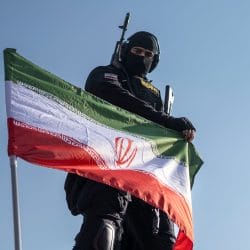
In February, the ‘New START treaty’, a mutual agreement between Russia and the U.S. to reduce and limit their nuclear arsenal, officially expired. The U.S. said China had conducted secret tests and that Beijing had to be part of any future non-proliferation agreement. For its part, the Chinese accused the U.S. government of seeking to mask its own expansionist ambitions. In the wake of the Iran war, started apparently because the Iranian regime was just days away from securing a bomb, other countries have spoken openly of their nuclear ambitions. After the start of the Iran war, North Korean leader Kim Jong Un spoke pointedly about preparing a nuclear-ready navy while inspecting a new destroyer and observing the testing of nuclear-capable cruise missiles. Even Polish prime minister Donald Tusk said Poland “will not want to be passive when it comes to nuclear security in a military context.”
On X, Tusk posted that Poland is in talks with France about joining its nuclear deterrence program. “We are arming together with our friends,” he wrote, “so that our enemies will never dare to attack us.” France is the only nuclear-capable European country, its systems (unlike the UK’s) completely independent of the U.S. and its new deterrence framework will include collaborations with Germany, Poland, Greece, Sweden, Denmark, the Netherlands and Belgium. Macron is calling France’s new strategy “advance deterrence,” a willingness to spread French nuclear armaments across the continent. A senior Pentagon official said the U.S. would “obviously at a minimum strenuously oppose” European countries seeking to acquire nuclear weapons. The U.S., as part of a NATO agreement, already deploys over 100 nuclear weapons in Europe — in Germany, Belgium, Italy, the Netherlands, and Turkey.
Europe’s anti-nuclear tradition grew out of grassroots movements in the 1970s. In West Germany, protests against a planned nuclear plant in the small wine-growing town of Wyhl began when local farmers feared pollution would destroy their land and crops. By the 1980s, millions of Europeans were protesting nuclear weapons and the deployment of NATO missiles across the continent, bringing nuclear security debates into the public arena and pushing governments toward disarmament efforts. The political impact of those protests were long-lasting. Across Europe, nuclear energy programs were curtailed or abandoned entirely. Denmark banned nuclear power plants in 1985, Germany shut down its last nuclear reactors in 2023, and several countries imposed strict limits on nuclear development. Nuclear technology, whether for energy or weapons, remained politically toxic in much of Europe. But, as Denmark’s Mette Frederiksen said European deterrence “is necessary because the military threat from Russia is expected to increase,” and its reliance on U.S. military support can arguably no longer be taken for granted.
Related Articles

At the Paris summit, China, Brazil, Belgium and Italy all signed up to a pledge to triple global nuclear capacity by 2050. South Africa signed the pledge earlier this month. The war in Iran has once again made clear that the world must wean itself off fossil fuels. The U.S. — which imposed additional tariffs on India for buying Russian oil and thus helping to finance the continuation of the war in Ukraine — has, since the start of the attack on Iran, told India it can continue to buy Russian oil. Delhi promptly bought 30 million barrels of Russian crude oil. But this month India also signed a deal with Canada to receive uranium to expand its nuclear energy program. But in 1974, Canada provided India with nuclear technology for peaceful uses that were promptly put towards the building of nuclear weapons. Nuclear collaborations between the two countries were suspended for decades. It’s not a coincidence that those ties are once again being revived in the current geopolitical context. A growing clamor for nuclear energy has clear proliferation risks.
While France has been talking about greater nuclear deterrence, most European states are speaking about a revival of nuclear energy as an alternative to fossil fuels and as a means to achieve climate goals. The vast energy requirements of AI and data centres is also prompting nations to adopt an “atoms for algorithms” strategy, to be, as Macron said, “at the heart of the artificial intelligence challenge.” But to talk about energy alone is to ignore the appeal nuclear deterrence has for nation states trying to navigate dangerous geopolitical straits. Iran was attacked ostensibly because it was on the verge of having a bomb. Favored nations such as Saudi Arabia are able to sign nuclear pacts that remove non-proliferation guardrails, but the actions of the U.S. and Israel in Iran will make the bomb attractive to many more as a national security strategy.
A version of this story was published in this week’s Coda Currents newsletter. Sign up here.