






Life on Europe’s most westerly edge exists between ancient rock and the wild waters of the Atlantic. It’s always raining. The wind has a bite and trees lean to one side, tired of fighting the howling gales. The surfing is spectacular. But it should be colder. Other places this far north, in Russia and Canada, are locked in ice. Ireland is famously green.
That’s largely thanks to AMOC, or the Atlantic Meridional Overturning Circulation.
Think of it as an ocean conveyor belt, taking hot water from the African coast, north-west to the Gulf of Mexico, then north-east to Ireland before it gets salty and cold off Greenland’s coast. Then it drops deep and heads down to Argentina before starting again. It’s been circulating this way for 12,000 years, since the last ice age. It is the reason why agricultural societies have thrived all along the Atlantic.
But now vast amounts of carbon dioxide are trapping more heat in the atmosphere. The heat must go somewhere. It’s going into the oceans. This is the hottest-ever year for the oceans, and everywhere else. Droughts and floods are just one marker of an unstable climate. AMOC is one of 16 tipping points scientists have identified that would suddenly, violently make things worse.
What happens to life on Earth if AMOC slows down, or collapses? For Western Europe and North America, it could mean a 20°C drop in temperatures and a new ice age. The last time that happened, this part of Ireland was under a kilometer of ice. In West Africa and Southeast Asia, life-giving monsoons may falter. No part of the world would be untouched.
In 2016, the United Nations’ climate agency said there was “high confidence” a collapse wouldn’t happen this century. In 2021 that dropped to “medium confidence.” Stefan Rahmstorf, an oceanographer who has been researching AMOC for 35 years, said in March that collapse was now “more likely than not.” Last August, researchers in The Netherlands ran 25 different climate models and concluded AMOC could start collapsing from 2063. This August, research in Nature Climate Change said the rate the world is heating is key, and that a collapse could start with a 2°C hotter world.


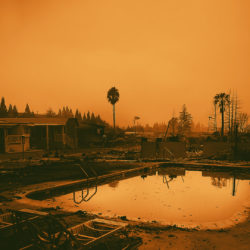
If every country reduces emissions at the rate they have promised on paper, heating will be at least 2.7°C.
To strengthen their predictions — so that we can all start to plan accordingly — scientists need data. For AMOC that comes from satellites, samples of ancient ice and, since 2001, buoys bobbing in the Atlantic. These tell scientists everything about that spot on Earth, like the air and sea temperature, wind direction, and noise from volcanoes.
The current U.S. administration, backed by billions in donations from the industries driving global heating, started pulling those buoys out of the water. It has also tried to force through deep cuts to climate monitoring units, like the Mauna Loa Observatory in Hawaii, one of the four key global datasets for carbon emissions. In June, scientists warned of the impacts of this, noting that the entirety of AMOC research gets just €25 million a year. (Editor’s note: instead of surveilling the oceans that sustain us, superpowers spend billions of dollars every year surveilling fellow humans).
So, the core driver of civilization around the Atlantic might start collapsing in 36 years. The models increasingly show that this scenario is more likely than not. But the data to help countries and people prepare is being systematically removed, or doesn’t get the funding to get collected in the first place.