







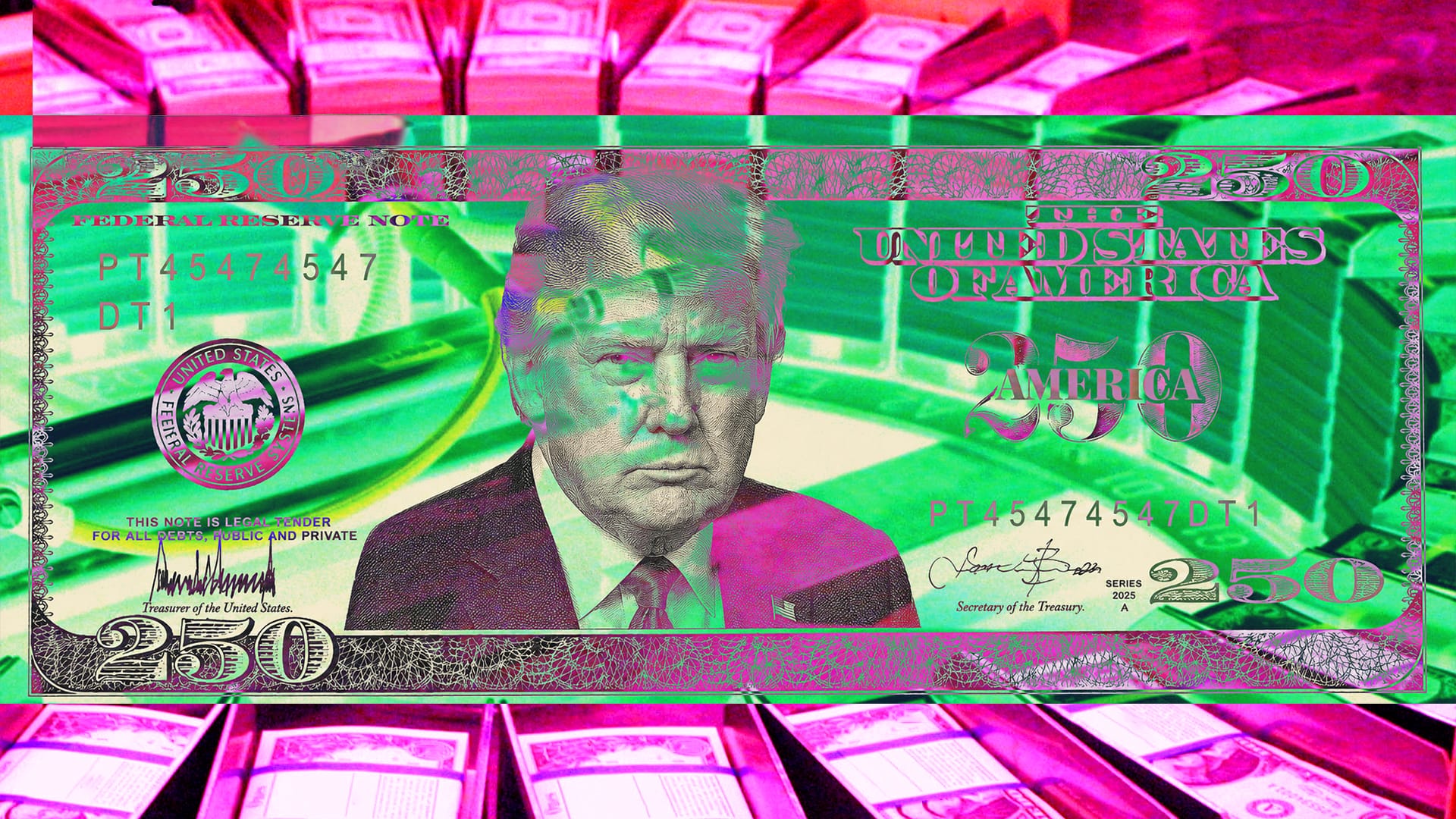
Donald Trump’s $250 gift to launderers and criminals

It has become a theme of this newsletter to lay out what is needed to tackle financial crime, and then to point out how the U.S. government is doing the opposite, and I assure you that I am as bored of it as you are. I try therefore to avoid writing about Donald Trump any more than I have to, but I’m afraid I very much do have to address the subject of the $250 bill.

Subscribe to our Coda Currents newsletter
Insights from the Coda newsroom on the global forces that shape local crises.
Criminals adore banknotes, thanks to their anonymity and convenience, and that love has only grown as the financial system has become more regulated. They love high-denomination banknotes most of all, because they let criminals move a lot of value in the smallest possible space.
This is why the proportion of $100 bills among the banknotes printed by the Federal Reserve increases year after year. Two decades ago, $100 bills made up 64.4% of the value of outstanding dollar banknotes; at the end of 2025, it was 81.8%. And the total number of notes has increased massively: 5.4 billion in late 2005; 19.9 billion last December.
If I could click my fingers and make one thing happen to stop money laundering, it would be to stop central banks printing large denomination banknotes (as has happened in the past in Singapore, and in the Eurozone). The Federal Reserve is not the only offender — the European Central Bank still has €200 bills, the Swiss have 1000 franc notes, the Brits have £50 notes – but the $100 is by far the most widespread of these big bills and thus the most egregious example. There are almost four times more of them in circulation than all the big euro-denominated bills added together.
So what is the White House doing about the problem of large denomination bank notes? “Trump administration officials have pressed the office responsible for printing the nation’s money to design a $250 bill featuring the president’s portrait,” reports the Washington Post. Treasury Secretary Scott Bessent said he didn’t think that there was anything “untoward” about having the current president of the United States on the 250th anniversary bill.
Look, I like the word “semiquincentennial” as much as anyone else who has had to squint at it for a while to work out what it means. And I appreciate that Americans are rightly proud of how long their republic lasted before beginning to turn into a monarchy, but it would be nice if someone in power at least acknowledged how grotesque it is to float the idea of printing a banknote that’s even more useful to criminals than the existing ones.
Sanctions need enforcement
There is better news from the United Kingdom, where the government has expanded its sanctions against crypto firms helping Russia finance its war in Ukraine, with a raft of new designations, including against HTX (previously known as Huobi), one of the largest exchanges in the world and one that is linked to billionaire Justin Sun, who has promised full compliance with the sanctions.
What is interesting about this is that the UK is getting ahead of the United States, with which it has historically cooperated closely when issuing sanctions. “Anyone that’s been in this space for a minute knows what a disaster Huobi is,” wrote crypto-watcher Richard Sanders on linkedin. “Quite frankly, the UK took an action the U.S. should have a long time ago. The UK realized the U.S. isn’t going to do this under the current administration. The UK, justly, got sick of waiting for this industry to do the right thing, as much as they got sick of waiting on other countries.”
That said, sanctions create a lot of compliance for law-abiding firms and individuals keen to avoid evading them. And the chances that law-breakers will be caught if they decide to engage with HTX regardless? Well, not very high, judging by a new report into the UK’s lead agency for serious and organised criminality.
“The National Crime Agency (NCA)’s IT infrastructure isn’t fit for purpose. This systemic weakness affects the entire agency,” the report says. “‘When I started in policing 15 to 20 years ago, I had better technology than I do in the NCA’,” one officer is quoted as saying.
So, how can officers trace online criminality if even their own systems don’t work? Not very well, not least since the government, in its futile attempts to stave off the political challenge from the far right, has assigned much of the agency’s workforce to tackling immigration (incredibly, even officers focussing on child sexual exploitation have been moved). “Some interviewees told us their teams were operating at 50 percent below previous levels. One interviewee told us that the effect of this was that they were ‘receiving more work with less resource’,” the report says.
Related Articles



So, once more, we are back to the old anti-money laundering model of more expensive compliance for the good guys, and no consequences for the baddies, since there is no one to investigate them. Sanctions are no substitution for police work, and one day someone will realise that. They work for a bit — see the graph of trades in the Russian cryptocurrency A7A5 for an example on Justin Sun’s Tron blockchain — but then someone works out a way around them, and everything carries on as before, because none of the people committing the crimes have been affected.
“The government has consistently failed to provide proper investment that would allow the NCA to provide an effective enforcement response to the range of serious threats the UK faces,” said Susan Hawley, head of Spotlight on Corruption.
But corrupt politicians and enforcement agencies can be exposed. So congratulations to the excellent folks at the French anti-corruption group Sherpa who have secured another victory in their delightfully successful campaign against the corrupt financial ties between Paris and the rulers of its former colonies in Africa. All the way back in 2007, Sherpa started its battle with French authorities that were refusing to investigate the wealth of their political allies. Thanks to its persistence, cases were brought against multiple politicians, most notably from Equatorial Guinea, and now the niece of Denis Sassou-Nguesso, president of the Republic of Congo. She will appeal, so this is not over, but it is further proof of how effective hard-working advocacy organisations can be.
A version of this story was published in this week’s Oligarchy newsletter. Sign up here.